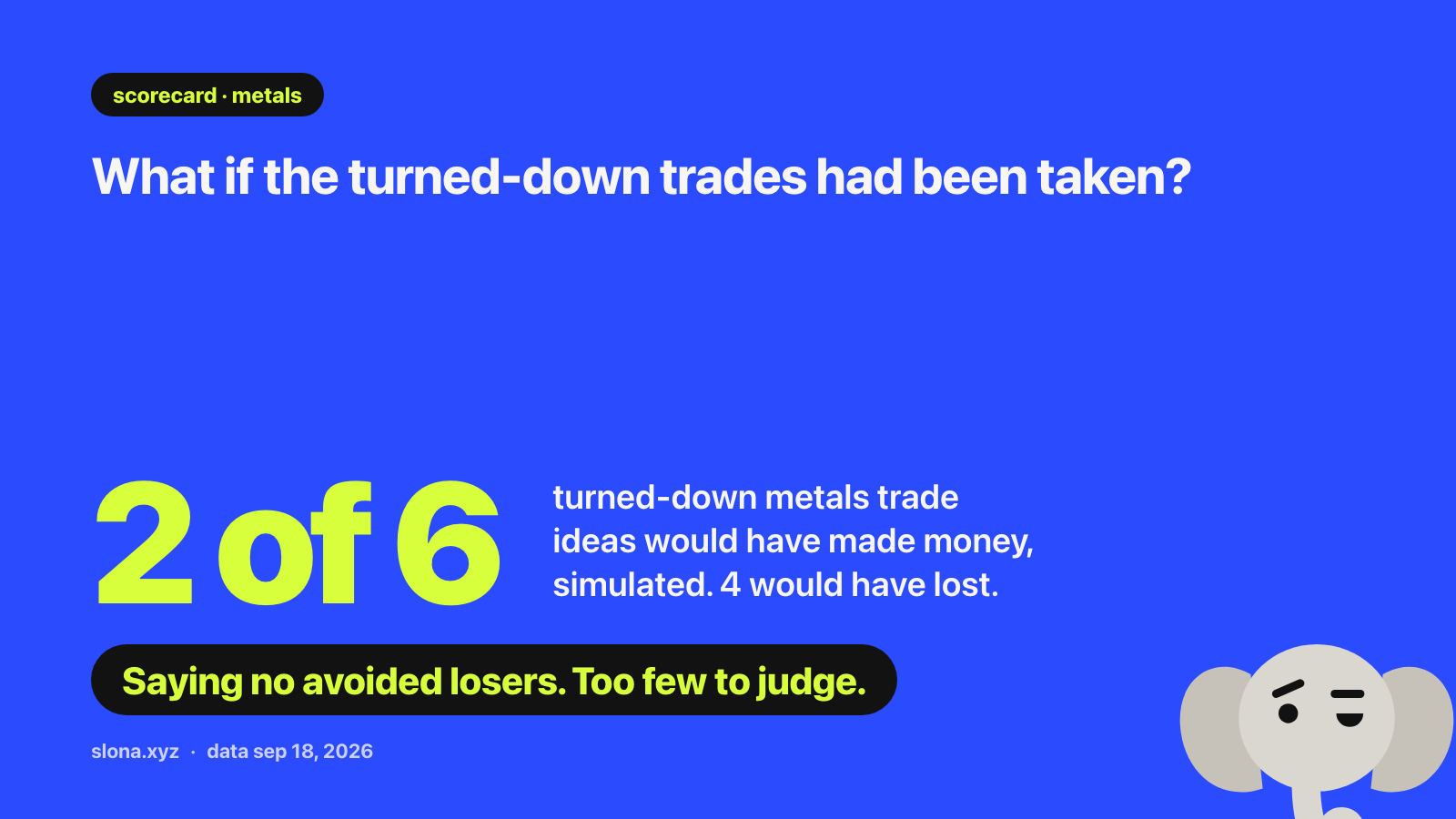
Card. What if the turned-down trades had been taken? Metals, Aug 10 to Sep 6: of 6 turned-down trade ideas simulated to the end, 2 would have made money and 4 would have lost. Saying no avoided losers. Too few to judge.
Sep 18, 2026 · scorecard · metals

What the rules said no to: metals

Before a trade idea is taken, a set of rules can say no. The scorecard does not forget those ideas: it simulates each one as if it had been taken.

Metals, Aug 10 to Sep 6: the rules said no to 13 trade ideas. 6 could be simulated to the end: 2 would have made money and 4 would have lost. The rest never got going.

Here, saying no avoided more losers than winners. Later weeks are added once their simulations have finished.

These are simulated trades, and 4 weeks are a small sample.

Should a filter be judged by the winners it blocks, or by the losers it stops?

Personal technical notes: market scenarios with probabilities and levels, generated semi-automatically. This is NOT financial advice or a recommendation to trade. Data may be incomplete, delayed, or incorrect; decisions and risk are entirely the reader's.

Where each number comes from

Receipts

Every number above was read by code from a line of a versioned measurement file, or counted and summed by code over the lines named. The version and the hash pin the exact text it came from. Data as of Sep 18, 2026 · 04:40 UTC.

NumbersMeasurementLineVersionSHA-256
Aug 10, Sep 6, 13, 6, 2, 4Setup scoreboard (metals)computed from 13 lines952ea80de1ddd8089b5

Caveats

  • Small sample: fewer than 30 cases, or marked as too few to use.
  • Mechanical shadow: simulated trades, not live results.
  • A measured frequency describes the history it was measured on. It is not a forecast.

The full disclaimer is part of the note above.